Athletic recovery, operated
Train.
Perform.
Recover.
Five recovery modalities, run by people who stay in the room. Below is what each one does, what the research actually supports — and, where the evidence is thin, we say that too.

The services
Five tools. Each one right for something specific.
Recovery is not one product. Pick by the problem you have, not by what is nearest the door.
- 01
Pneumatic Compression
Inflatable sleeves move sequential pressure up the limb for twenty to thirty minutes. The research signal is clearest for reduced soreness around the two-day mark, and close to absent for restoring performance.
20-30 min
Read the evidence - 02
Localized Cryotherapy
Cold applied to one specific area for a short period. The human evidence supports pain relief and stops there. The familiar claims about limiting damage and speeding tissue repair come from animal models.
5-15 min per area
Read the evidence - 03
Red Light Therapy
Red and near-infrared light applied to the skin, also called photobiomodulation. The strongest finding in the recent literature is for application before exercise, and it did not hold across every population tested.
10-20 min
Read the evidence - 04
Assisted Stretch Therapy
Guided stretching, including proprioceptive neuromuscular facilitation, where a practitioner controls the position and the tension. Range of motion is what it reliably changes, and when you schedule it decides whether it helps or costs you.
30-50 min
Read the evidence - 05
Vibration Therapy
Standing or resting on a plate that oscillates at a set frequency. The soreness and flexibility findings are real but bounded, and the performance literature calls the effect small and inconsistent, which is the reviewers' own phrase rather than a hedge added here.
10-15 min
Read the evidence
The evidence
What the research
actually says
Every claim below is graded, sourced, and carries its own counterweight. Some of it argues against the way these tools are normally sold.
- Moderate evidenceCompression
Compression reduced muscle soreness after exercise, with the effect clearest around 48 hours.
2024 systematic review and meta-analysis, Biology of Sport, 17 studies and 319 participants
The caveat: The benefit is not uniform across the recovery window. The same analysis found only a small, non-significant effect at 24 hours and a trivial one at 72 hours. The 48-hour result is the peak of an uneven curve, not a steady effect you can expect at any timepoint.
- Strong evidenceCryotherapy
Cold produces genuine short-term pain relief after injury or exercise.
2024 critical review of cryotherapy for soft tissue injuries in sport medicine
The caveat: The relief is short-lived and it is analgesia, not repair. Blunted pain can also let you load something harder than it is ready for, so the window right after cold is the wrong time to test how an injury feels.
- Moderate evidenceRed Light
Applying photobiomodulation before exercise improved muscle endurance and recovery of strength and muscle damage markers, with moderate to large effect sizes.
2024 meta-analysis of 34 randomized controlled trials, Lasers in Medical Science
The caveat: The result held in athletes and in sedentary participants but was ineffective in the physically active group in between, which is an odd pattern for a real physiological effect. The authors propose a muscle fibre explanation, but an inconsistent response across populations is a reason for caution.
- Limited evidenceAssisted Stretch
Assisted PNF stretching increases range of motion.
2018 systematic review, Physiotherapy Theory and Practice, 46 studies and 1,864 adults
The caveat: The same review rated the evidence low to very low quality across most comparisons and stated it could not conclude PNF is more or less effective than other stretching methods. The range gain is real; the claim this specific technique is uniquely best is not established.
- Moderate evidenceVibration
Vibration training reduced muscle soreness after exercise at 24, 48, and 72 hours, with the largest reduction at 48 hours.
2022 meta-analysis, Medicine, 16 randomized controlled trials and 431 participants
The caveat: The reported effect sizes are very large for a subjective pain scale, and the authors detected significant heterogeneity across small trials using frequencies from 3 to 120 Hz. That combination usually means an inflated magnitude. Take the direction as supported and the size as unreliable.
How a session works
Somebody operates it. That is the difference.
Tell us what hurts
A short conversation about the sport, the load you are carrying and what is sore. No intake theatre.
We pick the modality
Different problems answer to different tools, and the timing matters as much as the tool. Some of these work better before you compete than after.
An operator runs the session
Someone stays in the room, sets the dose and adjusts it. That is the part most recovery spaces skip.
You get the honest read
What to expect, when to come back, and when a session is not the answer. We would rather say so.
About TRZ
Recovery you can afford
to repeat
TRZ exists to put recovery technology in front of people who were never meant to be able to reach it — not only professional athletes, but weekend players, working adults and families.
Repetition is what actually moves quality of life. A single session is a nice afternoon; a habit is what changes how you feel in six weeks. That is why the pricing is built around coming back rather than around one expensive visit.
We operate the room ourselves. Equipment is the easy half — knowing which tool to reach for, at what dose, and when to tell someone to skip it is the half that takes a person.

Who it is for
For every athlete
Court sports, field sports, lanes and leagues. The load is different; the soreness is not.
Basketball

Bowling

Flag Football
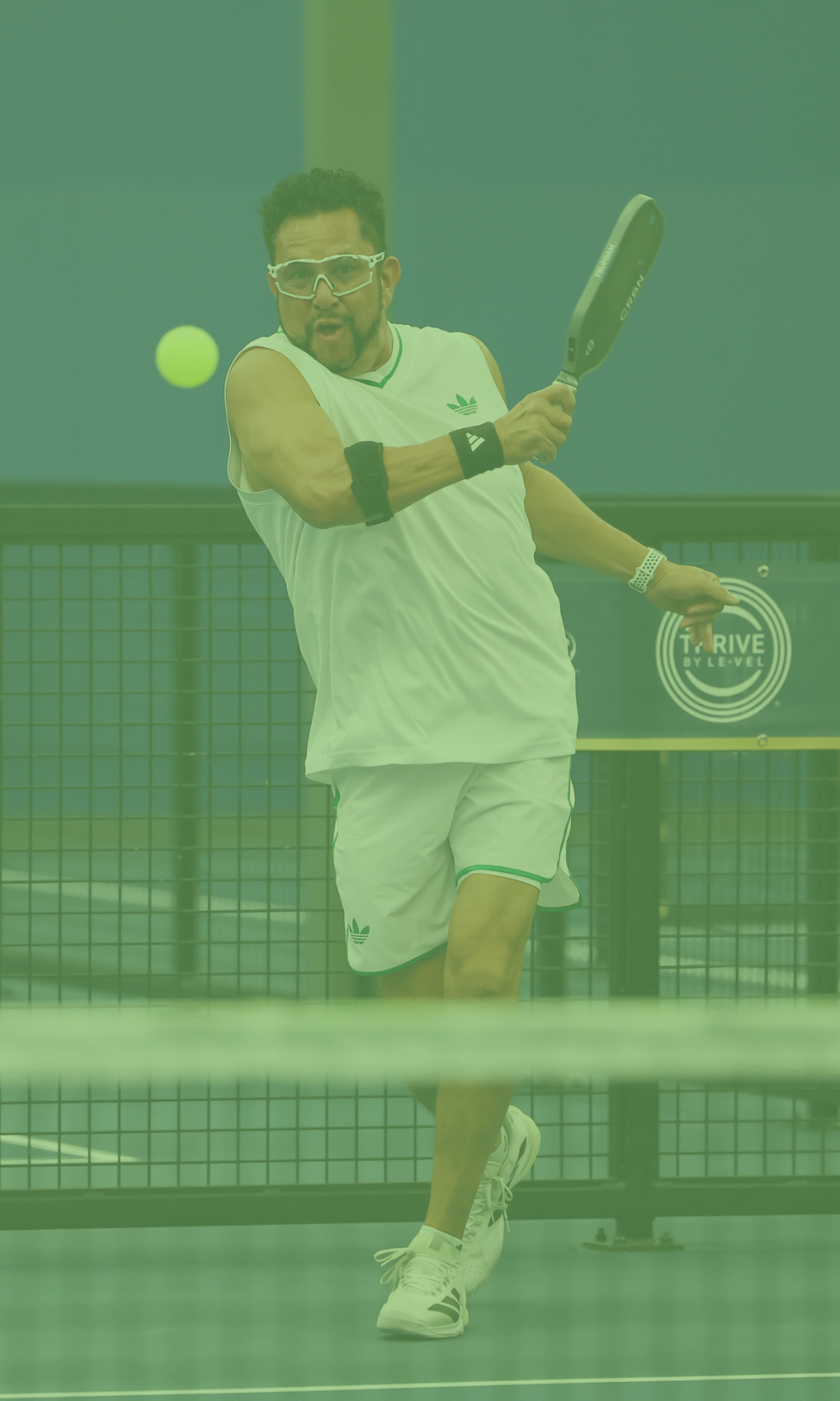
Pickleball
See a real session
We film the work
Sessions, setups and results, posted as they happen.
Trusted by
Events and organisations we have worked with


Official partner

Mueller Sports Medicine
Mueller designs and manufactures the braces, supports, tapes and wraps used from school sidelines to elite international sport. We carry their products because the people who use ours ask for them by name.
Founded in 1959, Mueller reports over 65 years of manufacturing and distribution in more than 100 countries. Those are Mueller’s credentials, not TRZ’s.


Mueller is an official supplier to the National Athletic Trainers’ Association and a partner of PFATS, NBATA and the World Federation of Athletic Training & Therapy.
Book a session
Tell us what hurts
Send the sport, the soreness and when you next compete. We will tell you which modality fits and when to take it — including if the answer is “not this week”.